top of page

Resources

Attention: I am responsible exclusively for Lectiones Antiquae. All other resources (including dictionaries) are not authored by me.

My audiobooks

Classical Latin audiobooks

Listen to Latin books written buy the the Romans who lived at the classical age, when Latin eloquence was at its peak! Practice your listening skills whenever and wherever you want!

Ecclesiastical Latin audiobooks

Practice your Latin listening to the wrintings of the most important catholic authors as well as the Scriptures themselves! 

adami.jpg
pithagorici2.png

Ancient Greek audiobooks

Audiobooks in Ancient Greek are available too! Practice you listening habilities and absorb the wisdom of the ancients as if they were talking to you!

Tutorials

image.png

Dialogus de Numeris is a dialogue between a Roman commander and one of his soldiers, Ariovistus, who is of Germanic origin. The conversation covers topics such as cardinal, ordinal, and distributive numbers and adjectives, as well as fractions, offering an almost exhaustive explanation of each. Different systems of numerical notation are also discussed throughout the dialogue.

Homo eiusque partes is a series devoted to the human body and the Latin names of its parts. It covers not only the principal parts of the body but also specialized vocabulary related to bones and organs, as these were named in the classical period.

image.png
image.png

Verba Latina intends to cover the Latin verbal conjugation in all its tenses and moods with exemples or dialogues. While the explanations are given in Latin, an English translation shall always accompany them. 

Dictionaries and Grammars

image_edited.jpg

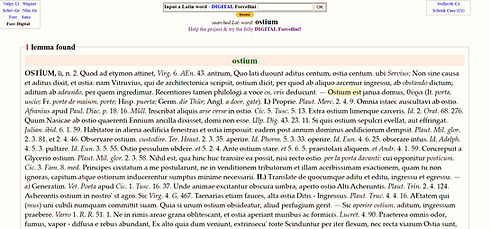
The Lexicon Totius Latinitatis by Egidio Forcellini is one of the most comprehensive Latin dictionaries ever compiled. First published in the 18th century, it meticulously documents the vocabulary, usage, and historical development of Latin from its earliest inscriptions to the Late Antique period. It is a useful tool for those to learn how to talk about Latin words in Latin.

Logeion is a free, open-access online dictionary and lexicon tool hosted by the University of Chicago. It has features such as aggregated dictionaries (Greek and Latin), information about the frequency of words, corpus examples, and morphological analysis.

image.png
image_edited.jpg

Wiktionnary is a multi-lingual, web-based dicionnary.  It is an invaluable resource for  Latin and Greek,  providing detailed definitions, and also including the etymology of words and extensive inflection tables (declensions for nouns/adjectives and conjugations for verbs).

Allen and Greenough Latin Grammar is one of the most respected and comprehensive reference grammars for Classical Latin, widely used by students and scholars across the English-speaking world for over a century. It is renowned for its depth, clarity, and systematic organization, covering the entire range of Latin language mechanics.

image.png
image.png

Thomas Dwight Goodell A School Grammar of Attic Greek is a highly respected reference text, similar in status to the contemporaneous Latin grammars, and is known for its pedagogical approach designed to help students master the intricacies of the Attic dialect.

Rhetoric was among the most important sciences in both Greece and Rome, especially in those regions and periods where speech was not suppressed by political power. Silva Rhetoricae is an excellent tool for learning the names of rhetorical figures and for recognizing their use and function when reading eloquent authors.

image.png

Online libraries

image.png

At Archive.org, you can find many old editions of books from the Ancient Greek and Roman, Medieval, Renaissance, and Modern periods  available for free download in PDF format.

The Perseus Digital Library provides digitized editions of Ancient Greek and Roman texts. It includes an integrated lexical tool and allows users to view or align the English translation alongside the original passage. It remains a valuable scholarly resource for the study of classical literature.

image.png

TheLatinLibrary, founded by William L. Carey, is a long-established free online collection of Latin texts spanning from Classical, through Medieval, to Christian and later Latin authors. While it doesn’t provide modern critical editions, translation tools, or editorial notes, it is extremely useful for accessing many texts quickly and directly — especially for reading and reference.

Documenta Catholica Omnia is a comprehensive digital library that gathers and preserves a vast collection of texts related to the history, theology, philosophy, and culture of the Catholic tradition. It includes writings from the Church Fathers, councils, popes, theologians, and scholars from antiquity to modern times.

image.png
image.png

Augustinus.it gathers and preserves the complete works of St. Augustine, not only in their original Latin, but also in Italian, English, Spanish, French, and German translations. It is a valuable resource for those who wish to use translations as an aid while becoming familiar with St. Augustine’s style.
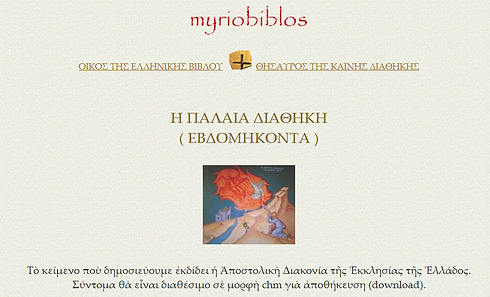
Myirobiblos contains the digitized version of the Septuagint as well as commentaries about the christian scriptures and faith written by men such as St. Basil the Great, St. Gregory of Nissa, St. Gregory Theologian, St. Athanasius the Great and others.

image.png
image.png

Poetry in Translation is a valuable resource for readers who still find Greek and Roman poetry challenging and would like support when reading authors such as Homer, Hesiod, Virgil, Horace, and many others. It offers a wide variety of works and selections, all easily accessible online.

© 2023 by Magister Ioannes.

bottom of page